|
Third Migrants & Refugee conference
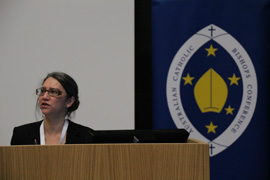
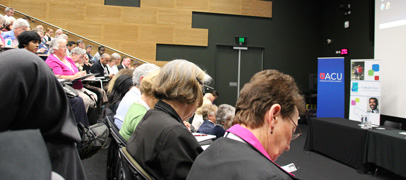
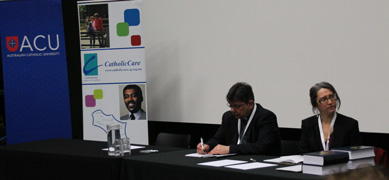
Several Marists (Brothers and Fathers) participated in the 3rd Australian Catholic Migrants and Refugee Conference in Melbourne, Dec 05-07. at St Patrick's campus of the Australian Catholic University.
The Brothers' work in East Timor and the Fathers' in Burma and Thailand were part of the background in pastoral care of refugees enriching the 200-strong conference group, led by the Bishops' representation for Migrants & Refugees, Bishop Gerard Hanna, and ACMRO director, Fr Maurizio Pettena CS.
For the work of the Australian Catholic Bishops' Migrant and Refugee Office go to their website www.acmro.catholic.org.au. |
| Participants from several states heard speakers from faith-based, community and government agencies share stories and statistics on a wide range of migrant and refugee topics. Key areas included facts, figures and stories about asylum seekers. the situations forcing them to flee their homelands, the positive fruits of refugee migrantion in Australia, treatment of international students, and first-hand stories of those in mandatory detention, including unaccompanied minors. Friday's sessions focussed on practical responses to refugee issues, including 'End Child Detention', 'Australian Homebase Network' and 'Helping Hand' programs. |
 |
 |
Tree of Hope celebrates past, present and future
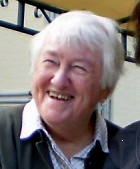
Sister Margaret Mines of the Sisters of Charity founded CatholicCare's Tree of Hope Centre in Surry Hills for the pastoral care of those with HIV/AIDS.
In Sydney on Nov 30 the Centre marked World AIDS Day (Dec 01) and also farewelled its premises in Surry Hills prior to its move to Lewisham.
This is Sydney Archdiocese's Catholic Communications' report of the event..... |
For the Centre, which was established in 1996 tomorrow represents a milestone in its 16 year history and is a time for all those involved with the Tree of Hope both now and in the past to reflect, remember and give thanks, says Margaret Pirotta, Co-ordinator of the Tree of Hope who took on the role after Sr Margaret's retirement from the role in 2007.
"With our move on 10 December, we also thought tomorrow would be a good time to look back as well as forward," says Margaret and explains this was also an ideal time for the Tree of Hope and CatholicCare to pay tribute to Sr Margaret for her vision, deep compassion and her contribution to the pastoral care to those who were ill, and in particular to those with HIV/AIDS.
Traditionally World AIDS Day is 1 December, but as this falls on a Saturday, Tree of Hope and its many friends and supporters decided to commemorate the day on Friday, 30 November so everyone past and present could attend and stay on to enjoy the Centre's final big get-together and barbecue at the Surry Hills premises.
Tomorrow's ceremony will be led by Father Peter Maher, Parish Priest at St Joseph's Catholic Church, Newtown. Also participating in the ceremony will be Brother Patrick McCarthy fsc, who worked closely with Sr Margaret when the Tree of Hope was first established, and Fr Jim Carty, the Centre's chaplain and CatholicCare's Manager of Pastoral Services.
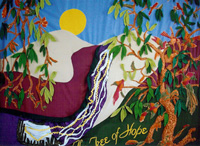
Long serving volunteer Mary Malady created Tree of Hope's spectacular wall hanging
The new expanded premises will enable the Centre to expand the pastoral, spiritual and emotional support it gives to those with HIV/AIDS to a broad area right across the city. These include plans for a series of regular monthly or quarterly events not only held at the Lewisham base but at leased premises in Devonshire Street, Surry Hills as well Liverpool in Sydney's outer west. There will also be drop-in time at the Tree of Hope's new Lewisham centre each month.
For Sr Margaret returning to Sydney and the Centre she founded 16 years ago is a chance to be reunited with her successor and friend, Margaret Pirotta and with another long time friend who helped her set up the Tree of Hope, Br Patrick. Sr Margaret is also hoping to see Larry Malady who with his late wife Mary was one of the Tree of Hope's earliest and longest serving volunteers.
"Mary made the Centre's beautiful wall hanging which symbolises the Tree of Hope," Sr Margaret says.
In addition to those who helped establish the Tree of Hope and volunteered their time and energies in those early days, Sr Margaret hopes to renew friendships with some of those who were diagnosed with HIV/AIDS more than 20 years ago and who, thanks to modern drugs and medical advances, are now middle-aged and in their 50s and 60s.
While there is still no cure for the virus and the drugs that help prevent HIV developing into full blown AIDS have severe side effects, the diagnosis of HIV/AIDS is no longer an automatic death sentence as it was back in he 1980s and early 1990s. Medical advances have meant many sufferers are leading relatively normal lives.
The first diagnosis of HIV/AIDS in Australia occurred back in 1982 at St Vincent's Hospital, Darlinghurst where Sr Margaret was a pastoral careworker. Over the next two years, numbers of those diagnosed with HIV/AIDS escalated at an alarming rate. With no cure and no drugs to halt progress of the virus, more and more young men and women were admitted to St Vincent's Hospital and the adjacent Sacred Heart Hospice where Sr Margaret gave them pastoral care, compassion, love and understanding.
"There were so many sick people and many of them died - all of them beautiful wonderful people. It was such a privilege to meet and know them," she says describing these early years of HIV/AIDS as "heartbreaking."
But it was not only the untimely deaths of so many in their late 20s and early 30s that troubled Sr Margaret but the discrimination and ostracism with which those with the virus had to contend.
[top of next column...] |
Fuelled by ignorance, prejudice and fear, discrimination against those diagnosed with HIV/AIDS reached a pinnacle in the late 1980s when people refused to even shake hands with someone who had the virus in case they became infected.
Princess Diana helped change this by hugging people with the virus on a visit to a London Hospital but discrimination was still rampant.
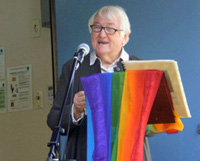
Sr Margaret Mines marking World AIDS Day at Sydney's Tree of Hope Centre
"I saw a great need to create a place of compassion where people with the virus could come to just be themselves, where nobody would be discriminated against, where there would be no labelling of people and where people, their families and their carers would be free to have the dignity God had already given them and be offered the respect that was their due," Sr Margaret says.
Although by the mid 1990s, there were excellent medical support systems and community services had been put in place for people with HIV/AIDS, she says there was nowhere for those with the virus to go that did not have an association with their illness and a medical connotation.
"What they needed was a place where for a short time they could forget about their illness and just be themselves and enjoy themselves," she says.
Sr Margaret's determination to establish such a place was shared by the then Archbishop of Sydney, Cardinal Edward Clancy who in the late 1980s had set up a committee to look into pastoral care for people with AIDS.
And it was thanks to this committee, the support of Cardinal Clancy and Sr Margaret's and the efforts of like-minded volunteers that the Tree of Hope was born.
Established in 1996 and housed in the grounds of St Patrick's Business College in Surry Hills, the Centre quickly became a haven for those with HIV/AIDS as well as their families and carers. Non-denominational and offering care and support to men and women of all faiths, as well as no faith at all, the Tree of Hope provided those with HIV/AIDS a place where they were always welcome, where they could make friends, be themselves, engage in social activities, find an outlet for their creativity whether this was poetry, painting or writing and be offered pastoral care as well emotional and practical support.
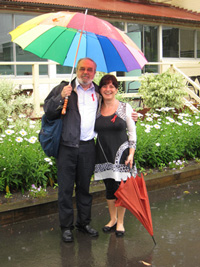
CatholicCare's Father Jim Carty SM and Margaret Pirotta at the Tree of Hope in Surry Hills
The Centre also offered outreach support and a friendly compassionate voice at the end of the phone.
Now after more than a decade and a half the Tree of Hope Centre is about to move to CatholicCare's hub of offices and services in Lewisham where it will be able to expand the pastoral, spiritual and emotional support given to those with HIV/AIDS and to their families and support persons.
"Leaving Surry Hills and our home here will be a wrench in some ways but it is also very exciting," says Margaret Pirotta.
Catholic Communications,
Sydney Archdiocese
Nov 29, 2012 |
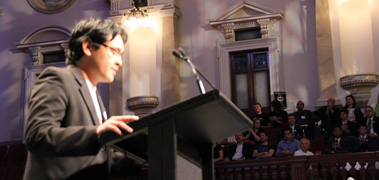
Catholic young adult speakers were prominent at the Sydney Alliance City Assembly |
Sydney Alliance City Assembly
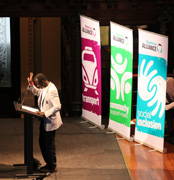
The second major assembly of the Sydney Alliance, attended by over 1,000 Sydneysiders was held in Sydney Town Hall on Oct 28.
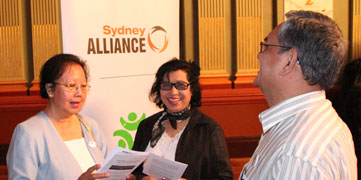
Representatives of numerous Catholic parishes, schools and groups in the Archdiocese of Sydney and the Dioceses of Parramatta and Broken Bay made up the largest contingents to the gathering.
Major issues were community support and health, transport and social Inclusion. See more of the Sydney Alliance at their web site. |
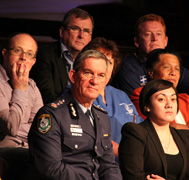
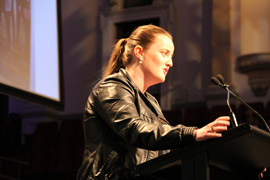
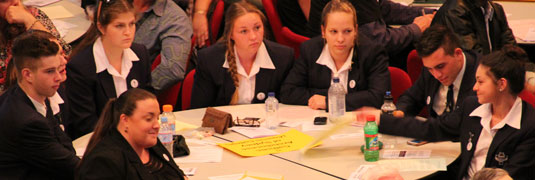
Above: Church, community, ethnic and union representatives were the key speakers at the City Assembly while listeners and other speakers included politicians and NSW Police Commissioner Andrew Scipione.
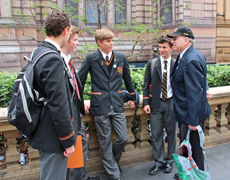
Below: Catholic high schools from three dioceses were well represented, including from Marist Kogarah, Marist Eastwood and Aquinas College, Menai. Bishop Peter Comensoli represented the Sydney Archdiocese. |
 |
 |
CLRI (NSW) - latest resources
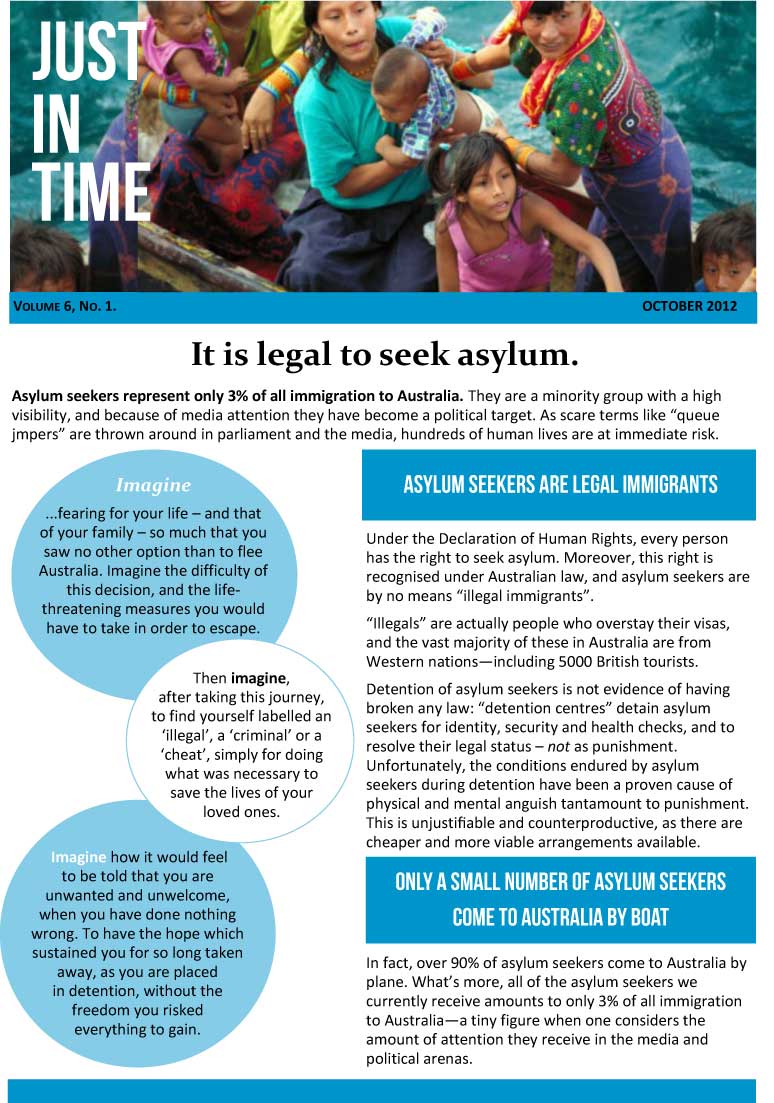
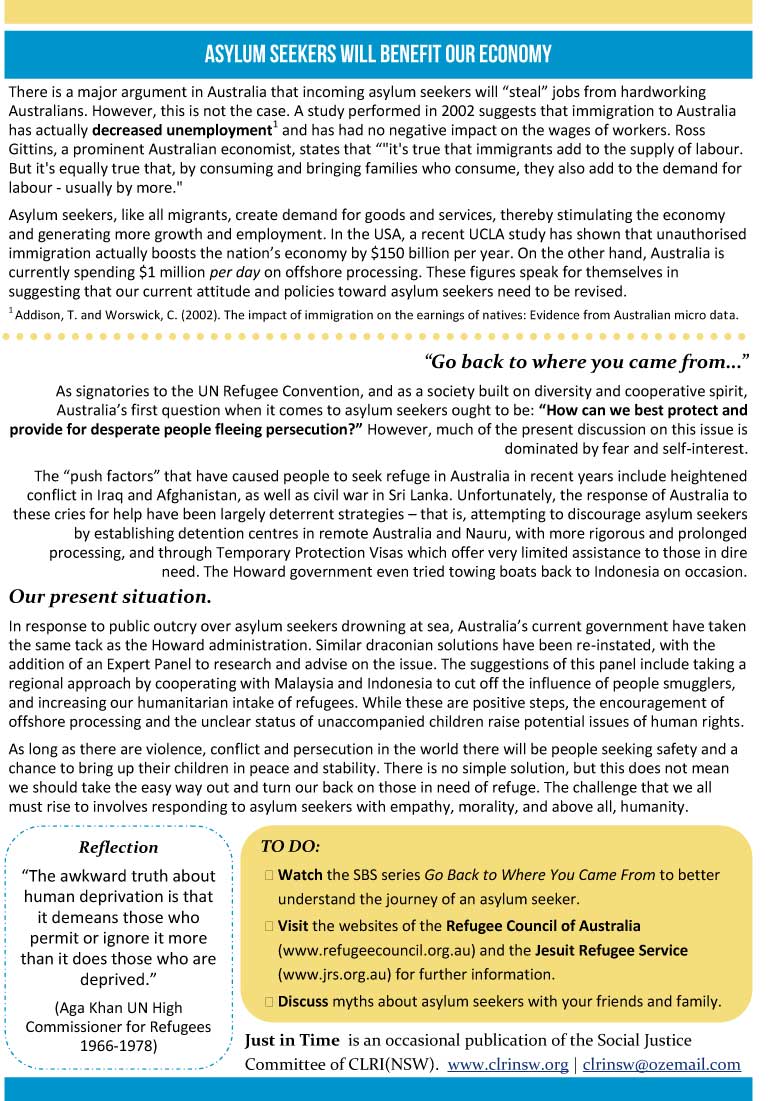
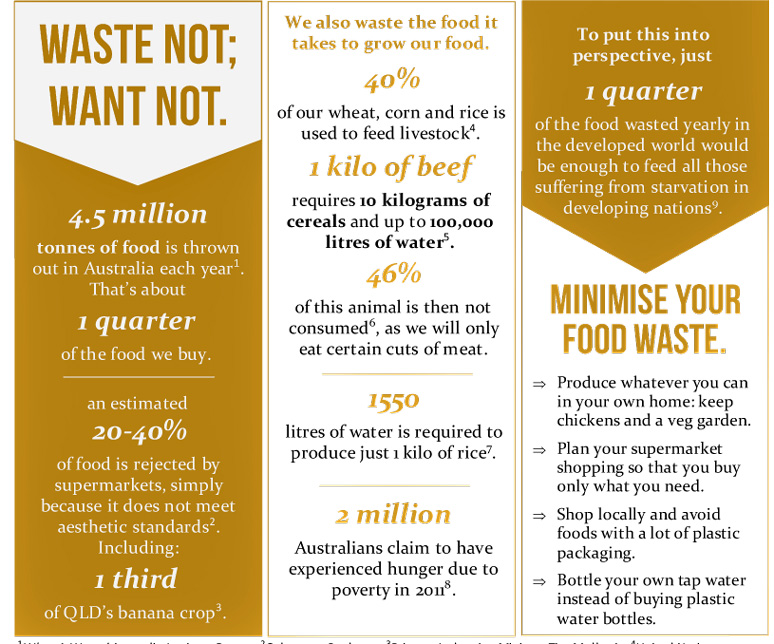
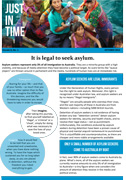
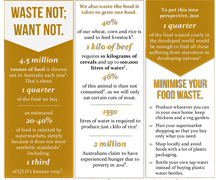
'Just in time' issue on Asylum Seekers and alarming facts on waste, 'Waste not, want not' (Tip: laminate it for your fridge door.)
Click below to download; click again to enlarge.
'Just in time' page 1 page 2
'
Waste not, want not' |
Two SMs in East Timor
Fr Paul Mahony recounts a recent visit to Timor Leste with confrere, Fr Harry Moore.
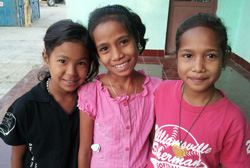
'God has a great sense of humour by sending the most beautiful people to the poorest countries.'
(Photos below) |
Harry and I set out for Timor Leste on Sep 17.
It is complicated arriving from Brisbane in Darwin at just after midnight and then waiting around the airport until 10 am.
The return trip has not been much better – the flight from Dili was two hours late arriving here just before 3 PM and we leave Darwin at 1AM – if the incoming flight arrives on time.
We were met in Dili by Brother Tony Clark FMS (Melbourne). In 2002 the Marist Brothers offered their services to the bishop of Baucau, the second largest city in Timor Leste.
They established a Teachers College that now has accreditation with the Australian Catholic University and turns out excellent teachers who will earn just $50 a month. The now Brothers have 5 young aspirants.
Portuguese is taught in all schools but it is very rarely used.
Having Portuguese from Brasil was an advantage but not a great deal as most people speak Tetum, Indonesian and their local dialects.
We were met by Fr Manoel a Salesian priest from Laga just 16 km but an hour’s drive from Baucau.
He was a wonderful host to us. He asked me to give a retreat day to the local Salesians. They have vocations!
10 young men were professed on 8th September and another 18 began novitiate that same day. |
Together with Indonesia their 40 year old East Timorese Provincial has 180 religious in the province.
Following the retreat day we went to Los Palos where they have a very large boarding school called Fuiloro.
This is an agricultural college. Fr Manoel was the rector of this college for a number of years.
Harry and I went with Fr Manoel to Baguia via Lavatery – it was all uphill over very rough roads.
The car was full of young people heading up to the mountain district to run Taize Prayer.
From Baguia we went to Afalaricai for a Mass up the mountain behind the school.
It was a very strenuous climb. It was different coming down in the dark with young people as our “safety officers” we both made it.
It was a long day on Monday to go from Laga to Baucau then to a wonderful work of the Salesians at Fatumaca where they have their house of initial formation with the 18 novices and about 40 aspirants and 200 students at a Technical School.
Students do woodwork, metal work, electrical and computer studies. Their graduates are well sought all over the country.
God has a great sense of humour by sending the most beautiful people to the poorest countries.
Fr Paul Mahony SM is the parish priest of Gladstone, Qld |
| |
 |
 |
|
|
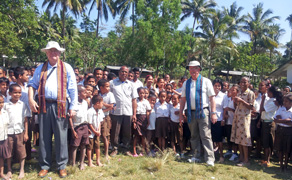
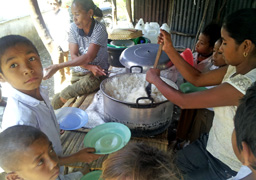
Above: Fr Harry and Fr Paul with the community of Lavatery / Fr Manoel celebrates Mass on the mountain at Afalaricai.
Lunch at Lavatery / First Communion preparations.
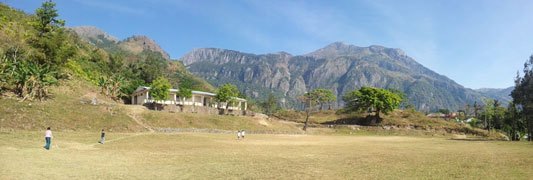
Below: School at Afalaricai / Countryside at Afalaricai.
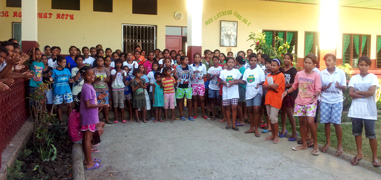
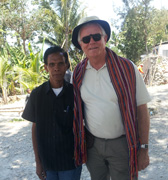
Further below: Orphanage girls. Fr Paul with Senhor Constantine, vice-dircetor of St Joseph's High School / Teachers from Gladstone cook Sunday lunch in the Orphanage. |
| |
 |
|
|
|
| |
 |
 |
|
Today's persecuted Christians: Defence of Christians a defining human rights struggle
Ucanews, Sep 13, 2012 (from National Catholic Reporter) |
In Nigeria, the militant Islamic Boko Haram movement has launched a religious cleansing campaign against Christians in the country’s north (see Page 14). It would be somewhat comforting to regard the atrocities there, which include machete-wielding fanatics attacking pregnant Christian women and young girls, as an isolated case.
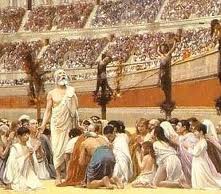
Alas, that option is not available to anyone whose eyes are open. Today, Christians are by far the most persecuted religious group on the planet.
As a result, defense of persecuted Christians is destined to be the defining religious freedom struggle -- indeed, a defining human rights struggle -- of the early 21st century.
As counterintuitive as it may seem for Westerners long accustomed to thinking of Christians as oppressors, not the oppressed, empirical confirmation of the point is depressingly easy to find.
- The Pew Forum estimates that Christians face persecution in a staggering total of 133 countries, representing two-thirds of all nations on earth.
- The Germany-based International Society for Human Rights, a secular organization, estimates that 80 percent of all acts of religious discrimination in the world are directed against Christians.
- Some 150,000 Christians are killed for their faith each year, according to both the Catholic relief agency Aid to the Church in Need and the evangelical group Open Doors.
Those statistics are fleshed out in all-too-numerous stories of Christians who paid the ultimate price during just the past year.
They include Mary Elizabeth Macías Castro, a Mexican Catholic laywoman and blogger, killed in September for exposing the activities of drug cartels; Sr. Valsa John, of the Sisters of Charity of Jesus and Mary, who was murdered in India for defending the tribal underclass against mining interests; and Shahbaz Bhatti, a Catholic and the lone Christian in the Pakistani cabinet, assassinated in March for opposing the country’s notorious blasphemy law. |
Swiss Cardinal Kurt Koch, the Vatican’s top official for relations with other Christians, recently proposed “Ecumenism of the Martyrs” as the new basis for unity, given that all Christian churches today share in the bloodshed.
Defending these Christians is not about parochial bias, or resurrecting some notion of the “church militant.”
Persecuted Christians deserve pride of place today for the same reason that Soviet Jews did in the 1970s, or black victims of apartheid did in South Africa during the 1980s -- because they’re the ones whose suffering is most acute.
Look for Catholic perspectives on the presidential election, a report from Joshua J. McElwee on his recent trip to Kenya and our Health & Well-Being section. Not a subscriber? Sign up today.
Nor is this an ideological crusade. While the majority of Christians suffer at the hands of Islamic extremists and communist states, both bêtes noires of Western conservatives, others have been killed by right-wing paramilitary groups and corporate interests seeking to squelch their advocacy on behalf of the poor.
No political camp has a monopoly on martyrdom.
While this global drama unfolds, the U.S. bishops recently launched a high-profile Ad Hoc Committee on Religious Liberty, dedicated to American church/state struggles such as proposed federal mandates on insurance coverage of contraception and abortion, and threats to erode the “ministerial exception” allowing religious groups to hire and fire in accord with their faith.
Tellingly, the committee’s first act was to hire lawyers.
Whatever one makes of the fights the bishops seem poised to pick, surely we can all agree that getting shot for one’s faith is more serious than getting sued.
One hopes, therefore, that the lethal threats facing vulnerable Christians around the world will galvanize at least as much energy from the bishops, and the broader Catholic community, as the legal and political difficulties on the domestic front.
First reported in National Catholic Reporter, Jan 2012
|
 |
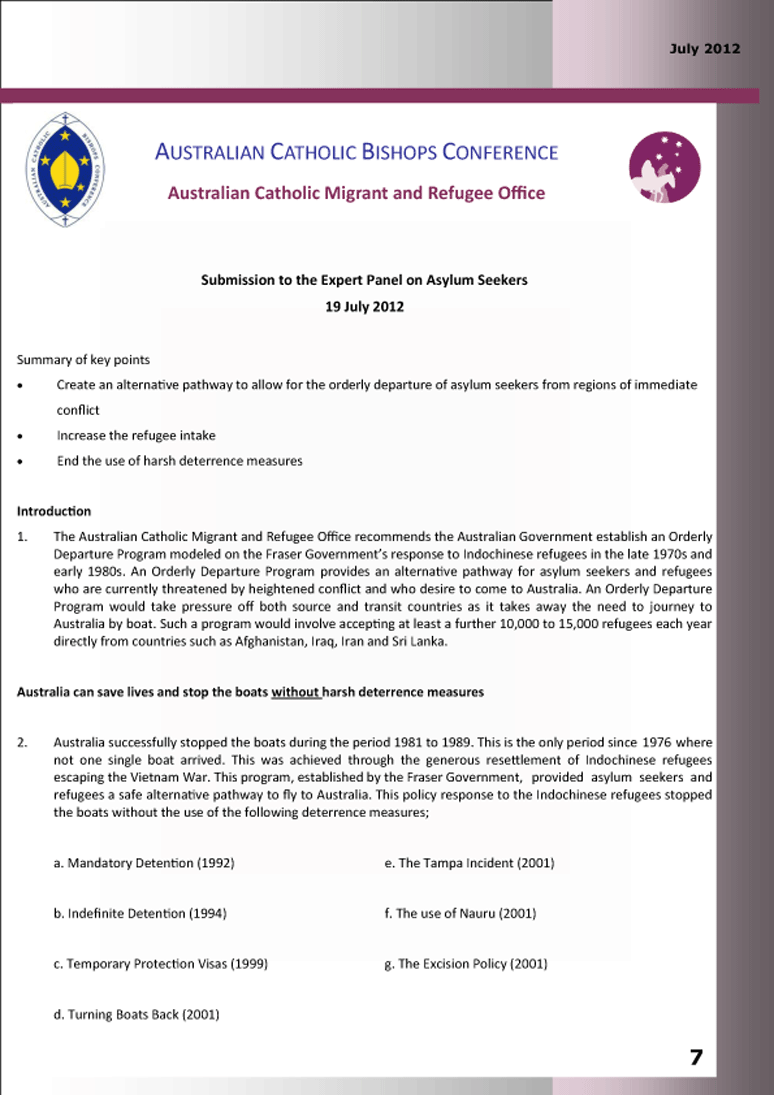
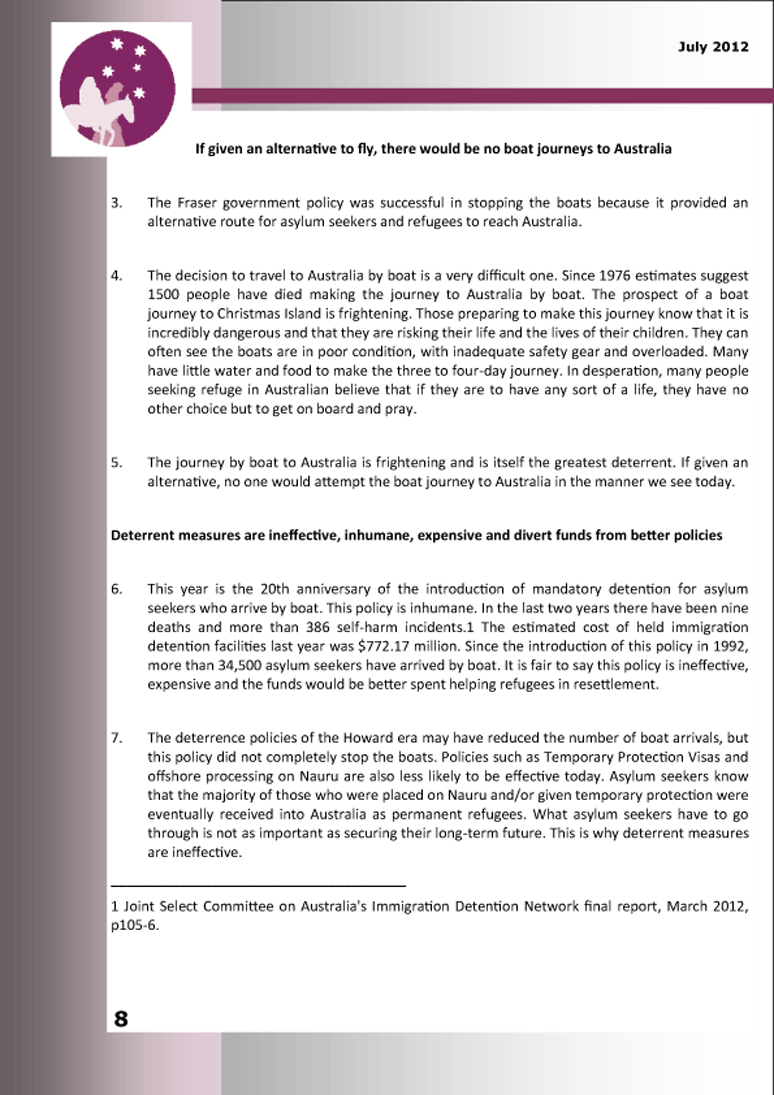
Bishops' submission on asylum seekers
Click below for each of the four pages of the report. Click again to enlarge.
Page 1
Page 2
Page 3
Page 4 |
The Siege of Kachin State
President of the Kachin Association of Australia reports: 'The Burmese Government does not want you and the world to see and know the crisis in Northern Burma....' |
Perth based a lawyer and activist, Scott Johnson, went to Laiza and Kachin-China border in early January and documented hours & hours of footage of current situation, interviews with Human Rights abused victims, IDPs, KIA, Burma Campaign UK regarding the Kachin crisis in northern Burma.
To date there are an estimated 75,000 people forced out of their homes with nowhere to go and confined to impoverished, makeshift camps.
Click here for 'Siege of Kachin State' on YouTube.
Meanwhile Burma's 'Tribal Action Group' (click here for their web site and videos) comments:'While the international community drops sanctions against the Burmese regime, the war against the ethnic Kachin people continues and now over 60,000 refugees have fled the attacking Burmese army. Human Rights abuses including rape and murder have been committed by the Burmese military. Hundreds of Burmese Army Battalions have surrounded Laiza and Kachin State.' |
"Inhumane and lacks integrity"
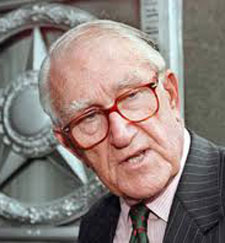
Former prime minister, Malcom Fraser, on the Coalition's latest asylum seeker plan: "Abbott's evil policy work" |
Tony Abbott and Scott Morrison recently stood in front of Australia and proudly presented the Coalition's plan to ''ensure integrity and restore confidence in refugee assessment''.
There is not much to be proud about in this policy. The announcement was based on misinformed and misleading information that plays straight into the unfounded public fear of asylum seekers.
How can you ''restore integrity'' to the policy affecting asylum seekers when the proposals embraced are based on falsehoods, misinformation and a blatant playing of politics with the lives of vulnerable people?
This is the opposite of integrity. It is inhumane and demeans Australia. Is this the basis on which Abbott will operate if he, as he believes he will, becomes prime minister?
Australia has a robust and effective legal system to assess whether or not someone is a refugee.
Declaring that a tougher and more rigorous process is required ignores the fact that we do not have an asylum seeker problem and we have not lost control of our borders.
In 2010-11, 4730 asylum seekers arrived by boat. During the same period, more than 13 million people crossed our borders and arrived in Australia; 4730 out of 13.9 million is not a ''system vulnerable to abuse''. Instead of restoring ''integrity and public confidence'', the Coalition's policy is detrimental to people seeking asylum, breaches our obligations under the Refugee Convention and appears to work from the position of the assumption of guilt.
The most effective way to restore integrity and public confidence in asylum seeker policy is through strong leadership, myth busting and accurate information.
Not to present a policy that is the closest thing to evil you can get. A policy that is full of misinformation.
To begin, Abbott referred to ''illegal boat arrivals'' - yet we have been reminded numerous times that it is not illegal to seek asylum, regardless of mode of arrival.
How can we expect the public to know facts such as this when a possible future prime minister of Australia doesn't?
One of the main points of the Coalition policy is to introduce an independent Integrity Commissioner for Refugee Status Assessment.
Yet the current administrative arrangements in the Department of Immigration and Citizenship already include rigorous assessment of applications, plus summaries of trends and totals.
The Coalition's proposed six-monthly audits would add little that is new and would undermine an existing, robust government department.
Another major part of the policy is to draw an unfavourable inference about an applicant's identity if they arrive without documents.
The reference to ''90 per cent of arrivals having no documents whatsoever'' is a blatant attempt to mislead the public.
A footnote refers to a budget estimates hearing relating to asylum seekers arriving without a passport. |
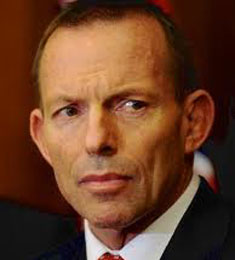
But arriving without a passport is not the same as arriving with no documents ''whatsoever''. While people may arrive without a passport, it does not mean they do not have other identity documents.
There are numerous reasons people arrive without a passport: they may not have one, they have had to hand it over to people smugglers, or they have panicked and destroyed it because it is their identity that has caused persecution, torture and imprisonment in the past.
Further to this, to prove an asylum seeker is a refugee, identity documents must be provided - therefore there is no way to be found to be a refugee without any documents.
This is not indicative of a system ''wide open to abuse'' or one in which assessors are forced to make a ''best guess''.
The reason nine out of 10 people who arrive by boat receive visas is that they have proved they are refugees.
They have provided identifying documents and have proved that owing to a ''well-founded fear of being persecuted for reasons of race, religion, nationality, membership of a particular social group or political opinion'' they are unable to return to their home country.
Fear that has forced them to flee and seek protection in Australia. Protection that, as signatories to the Refugee Convention, we are obliged to offer and should be proud to offer.
Asylum seekers are not granted refugee status because they do not have documents or are cheating a vulnerable system.
The presumption that people who arrive in Australia seeking our protection are trying to cheat our system is offensive.
As a final indication of the value of this policy, it refers to section 49A of the Migration Act. There is no section 49A.
This policy lacks substance and needs to be seen for what it is - opportunistic and based on misinformation. It fuels an unfounded fear and ignores what asylum seeker policy should be based on - humanity.
One thing Abbott is right about is that integrity needs to be restored - but not with the system, as he asserts. What is missing is integrity in the presentation of information and integrity in our politicians and their policies.
The race to the bottom of the barrel in the asylum seeker debate continues and, with this policy, Tony Abbott is winning.
Malcolm Fraser was Liberal prime minister from 1975 to 1983.
www.theage.com.au, Opinion Jun 18, 2012
|
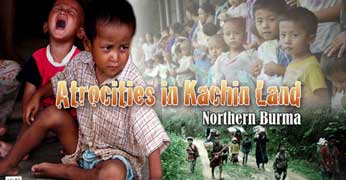
Atrocities in Kachin Land
|
The Kachin people of northern Burma continue to suffer at thehands of the military junta.
In June 2011 the Burmese junta launched a military offensive against the Kachin ending a 17 year ceasefire. Villages have been destroyed, crops devasted, women raped, shops ransacked and many people murdered. Starvation, forced relocation and disease have resulted.
A recently-released video drawn from a number of news services including BBC News and AlJazeera depicts the plight on the Kachins. Click here
See also below 'Australian response to Kachin plight' |
 |
Australian response to Kachin plight
The number of Kachin families in Australia is small but passionate in their concern for the plight of their people in Burma.
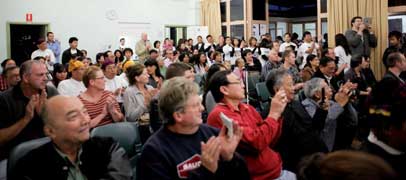
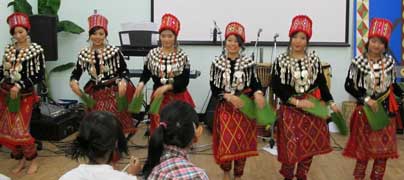
Recently the Kachin Association of Australia held an awareness- and fund-raising function in Sydney's outer west. With dance, song and traditional food the gathering also heard from the president of KAA. (See below) |
| |
 |
 |
|
|
Kachin Association of Australia -- president's address... |
THE WAR ERUPTED
Almost a year ago (June 9th 2011), Burmese military broke a 17-years-old truce, the armed conflict was erupted between the Military and Kachin Independence Army (KIA).
Today that conflict has turned into full-scale war and President Thein Sein's government is unable to stop the Military waging all-out brutal assault on KIO/ KIA and innocent Kachin people are targeted under the excuse of war against the KIA.
MILITARY Build-up
Not only the massive military build-up, also Burma Armed Forces are deploying as many as 120 battalions in Kachin State and of those 69 battalions and estimated over 40,000 soldiers and plain-clothe army officers with latest military hardware and arsenal in attempt to crush KIO and KIA.
The scenario illustrates that while Burmese government is saying rhetorical peace plan, its armed forces have been advancing to crush the KIO controlled town of Laiza which currently is sheltering over 50,000 displaced peoples. It means the government has no genuine purpose to begin meaningful political negotiations and end the Kachin crisis.
REPORT OF HUMAN RIGHTS ABUSES
While the central quasi civilian government has been praised internationally as "reformists", innocent ethnic civilians are subjected to appalling atrocities such as systematic rape and torture as a weapon of war, extra-judicial killings and other forms of serious Human Rights abuses by its Army.
Kachin Women Association Thailand (KWAT), Human Right Watch (HRW) and Partners Relief & Development groups documented the reports and eye-witness accounts of serious Human Rights abuses, and have accused Burmese troops of committing war crimes against Kachin, Karen, Shan and other ethnics.
Other News network the likes of Al-Jazeera, BBC London also reported and interviewed the numerous eye-witness accounts from the victims being abused by the Burma army which you will see soon in the video.
If these atrocities are happening in or around Rangoon, like the attacks that had happened in 2007 Saffron Revolution, there would be international outrage. "No one would be talking about lifting or easing sanctions" But because it happens out of sight in the mountains in Ethnic states, United Nation, international communities continue to ignore the severity of these appalling atrocities.
The Government that claims to be involved in the "Reform and Democratization", the newly elected party that said will "bring peace and an end to ethnic conflict" have so far no mention of these appalling atrocities and serious Human Right violations, let alone taking action and bringing the justice.
IDPs CRISIS
Today, it is estimated that over 75,000 people have been forced out of their homes and fled as a result of forced relocation, the soldiers went on the rampage, terrorising, systematic raping, extrajudicial killing, looting, burning villages, using villagers as forced labour.
Over 50,000 had fled and took refuge in KIO controlled areas around Laiza and near China border with living in improvised camps. Over 20,000 fled to the areas and towns where local Christian churches, local Kachin relief groups are sheltering with inadequate supplies. Thousands more are still hiding in remote mountainous areas.
These people are now in desperate need of basic supplies - food, medicine and shelter. Children, frail and elderly have died and many are dying from treatable diseases. UN have accessed 2-3 times to the reachable areas with very limited supplies. The access to some of the worst hit areas are still being denied by both Burma and China authorities.
These IDPs need immediate protection from UN and urgent assistance from the international communities as the harsh monsoon season approaches in June with the onset of water born diseases, insufficient shelter and inadequate medical facilities.
Local NGOs such as Pan Kachin, Winpawng Ninghtoi, RANIR, Kachin Baptist Convention (KBC), Metta Foundations, Catholic Dioceses of Bhamo and Myikyina, Gayuna, other Christian communities have been engaging aid and relief for the IDPs and with limited resources but they need more help to reach out to more IDPs in dire situations.
[top of next column...]
|
Other International Christian Organisations likes Partners Relief & Development, Christian Solidarity Worldwide are providing foods and education supplies like wise, they are overwhelmed with the large numbers of IDPs.
As the attacks on innocent civilians continue unabated with no end in sight, the situation of the IDPs is worsening as the IDPs numbers continue to increase. The attack of Laiza would almost certainly lead to even greater humanitarian disaster. The disaster that will not only add to 75,000 IDPs, but will also add to the appalling toll of human lives lost and human lives destroyed.
We call upon Australian Government directly providing aid to these local relief agencies as they have the people working on the ground directly with IDPs. In the past that we have seen the Burmese Government agencies' in Burma exploiting foreign aid provided by international communities.
With the help of donations from supporters such as you, we are committed to provide funds to local Relief groups to buy live-saving medicines, essential supplies for the children and the people needed the most.
IN SUMMARY
If Australian government, UN and international communities are serious about long-suffering people of Burma to be on a genuine path to democracy, they must not turn a blind eye to appalling atrocities and serious Human Right violations happening in Kachin state today and other ethnic states.
"For the immediate and swift resolution" To stop this humanitarian crisis in Kachin State, the solutions are very clear;
• stop the offensive attacks and withdraw the troops immediately from Kachin state,
• allow the safe passage of all displaced civilians to return home and rebuild their lives
• allow the foreign aid go though directly to these IDPs
• allow the UN to freely access these camps
• Government to engage in genuine political dialogue with Kachin Independence Organisation rather than superficial ceasefires.
This is time for any Governments that claim moral authority NOT to turn their backs on the Kachin crisis. This is the time that Australian Govt should stand up and say very directly to the Burmese Govt and to the Chinese Govt that supports them,
This is the time Australian Government should say to the civilians and military leaders, "withdraw your troops and get out of the War"
Australians need to make in absolutely clear that there will be no foreign investments in Burma, in any part of Burma as long as the war like this continue, as long as civilians are targeted, as long as basic Human Rights are denied.
"For long Term solution" To achieve true democracy and long lasting peace in Burma, The Burmese Government needs to address National reconciliation, equalities on ethnic people and bring justice to those perpetrators responsible for committing war crimes on innocent civilians.
This is very crucial foundation in the national re-building. Without that, with all these reforms going on, it is not going to last. The unresolved political issues will send Burma back to the 1960s where the country was regarded as open and central Burma enjoys foreign aids and investment while ethnic states suffered economically and politically, and hence, the ethnic resistance began.
The talk of reform in Naypyidaw, and visitation from high-profile Foreign dignitaries have NOT reached the resolution of ethnic conflicts, Human Right violations.
The faith of these 75,000 IDP is largely unknown, thousands have lost their loved ones. Their homes, properties and villages are burnt to ground. They have nowhere to run as the Government troops are advancing for the brutal offensive war on KIA.
Only with your support and compassion, they will be able to survive in rugged mountains of Kachin and hopefully they will rebuild their lives.
May 2012 |
 |
BP-ers report on Suu Kyi's visit to Mae La
|
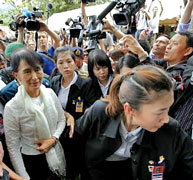
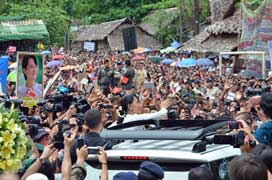
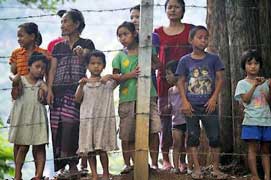
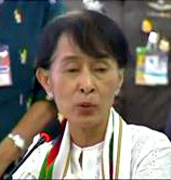
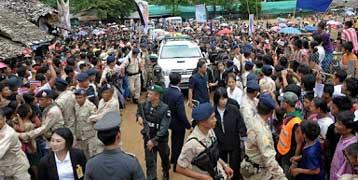
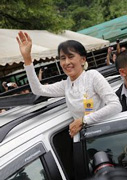
Eight mermbers of the Marist 'Bridge Program' live in the giant Mae La refugee camp on the Thai-Burma border. Through online tutoring the program prepares refugee youth to apply for Australian Catholic University's tertiary online program. Two BP-ers give first-hand reports of the visit of Aung San Suu Kyi on Jun 02, 2012.
Saw Din Goh Htoo: "Daw Suu Kyi was not allowed to give speech in front of people, but we asked her to tell something and she said, "Keep trying for your education while living in this hardship time - Refugee camp. Don't waste your time doing anything wrong - keep working with her," Actually, someone toldme this -- I could not hear her giving speech because the crowd shouted a lot! It is my luck that I have seen her.
"My feeling at that time was very happy,excited,and sad because she try to come to Mae La to help us.
Because she was not allowed to give speech to cheer all refugees up. She couldn't do anything because Thai authority did not allow her for these reasons. I feel to come and talk to our, refugees', future and I will always pray for her. This is what I was thinking about while she was coming."
|
Naw Paw Eh Htoo tells of her experience of Daw Suu Kyi's visit...
"Today made me so excited! When we Victoria and I went to Football
Ground, we could not go along the main road of Mae La Camp because there were so securities guarded there. so we tried to go there through the houses in the camp where I have never been before.
"But I am so pleased because I saw Daw Aung San Suu Kyi' close smiling face. It made me so peaceful in my mind. we our refugees could not be close to her because the female securities were hand in hand like a circle and she was inside them.
"Victoria and I tried to reach to her through the Thai soldiers and Camp Securities. So that we had a chance to see her close smiling face and heard her speeches; she told us to be clever, to try hard studying and to use time effectively. I could hear all her speeches because her voice is so soft and no microphone." |
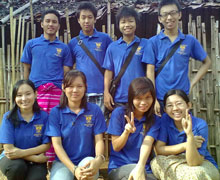
Bridge Program participants of Mae La in their BP polo shirts.
|
| |
 |
 |
|
|
Suu Kyi visits Karen refugees in Thailand
Aljazeera reports on the Jun 02 visit of NLD leader, Aung San Suu Kyi to Mae La refugee camp
| Aung San Suu Kyi, Myanmar's opposition leader, has visited an ethnic Karen refugee camp on the Thai border, telling thousands of people that their plight has not been forgotten.
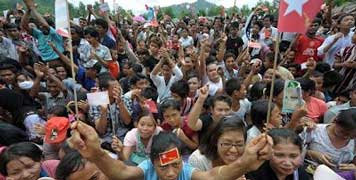
Inside the Mae La refugee camp, home to about 45,000 people who have fled war at home, she stood on a plastic chair and addressed the cheering crowds without the aid of a microphone.
"I will try as much as I can for you to go back home." she shouted. "I will not forget you all."
Refugees waved flags and chanted: "Long live Mother Suu."
The part of the Thai border where the Mae La camp is located is home to up to 140,000 Karen refugees.
The Karen have been waging a war for greater autonomy since Burma, as Myanmar used to be known, obtained independence from Britain in 1948, one of the longest-running such conflicts in the world.
Her six-day journey to Thailand is the first trip abroad in 24 years for Suu Kyi, who this year made the transition from former political prisoner to opposition parliamentarian.
In recent weeks, the group has been in negotiations with the government to end the fighting.
Last month, leaders from the Karen National Union met President Thein Sein's military-backed government as well as Suu Kyi to firm up a ceasefire they agreed to in January.
[top of next column...]
|
Millions of migrants
Suu Kyi also visited the town of Mahachai, outside Bangkok, home to Thailand's largest population of Myanmar migrants.
Many of the 2.5 million migrants crossed the borders illegally to work in low-skilled jobs for long hours at pay below their Thai counterparts. They typically lack health and social security benefits
Myanmar's economy, in ruins after half a century of military rule and years of harsh Western sanctions, has led to huge unemployment and has forced millions of people to seek jobs abroad.
Suu Kyi has repeatedly said she believes Sein is truly committed to democratic reform, but this week she warned the international community to exercise caution and a "healthy scepticism," saying the nation's all-powerful military was still a force "to be reckoned with".
Suu Kyi spent 15 out of 22 years locked under house arrest by the former military regime.
Even when she was not under house arrest, she refused to leave the country because she feared the former ruling generals would not let her return.
She was granted freedom after Myanmar held elections in 2010 and was elected to parliament in April.
Suu Kyi is due to return to Myanmar on Sunday, but next month she flies to five countries in Europe, including Norway, where she will formally accept her Nobel Peace Prize, 21 years after winning it.
|
A Theology of Migration
A new method for understanding a God on the move
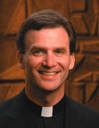
Daniel G. Groody
Fr Daniel G. Groody, C.S.C., an associate professor of theology at the University of Notre Dame, has written articles and books on migration, globalization and theology, including Globalization, Spirituality, and Justice: Navigating a Path to Peace. His films include the documentary “Dying to Live: A Migrant’s Journey.”
International statistics
In a recent visit to Loreto High School at Normanhurst Australia as a guest speaker Fr Daniel began his presentation with some statistics:
- 19% of the world lives on less than $1 per day
- 48% of the world lives on less than $2 per day
- 75% of the world lives on less than $10 per day
- The three richest people in the world have as much as the poorest 48 nations combined
- 212 million migrants are on the move in the world, which is equal to 1 in every 35 people, which is equal to the population of Brazil
- It is estimated that there are 12 - 27 million people being trafficked in the world, mostly for labour and/or sex.
| As a graduate student in theology, I lived in a large university town near San Francisco.
My room was in the basement of the house, where I spent many hours studying some of the best thinkers in the Christian tradition.
After getting up one morning, I looked out my window. On the other side of the wall from where I had slept was a homeless man.
Physically we were little more than a foot-and-a-half away from each other. Existentially, however, we lived in two different worlds.
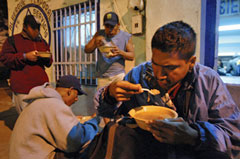
My reality was a comfortable home, a warm bed and a life of the mind; his was distress and discomfort, a brick mattress and a life of the streets.
That experience changed not only the way I thought about theology but also the way I began to do it.
I pondered what the world might look like from his side of the wall: how he thought about life, what he learned about people and, more to the point, if and how he understood God.
I had read enough Scripture to know of Christ’s self-identification with the hungry, thirsty, naked, sick, imprisoned and estranged (Mt 25:31-46), but I wondered if my neighbor’s social location gave him a better vantage point than my own from which to understand theological realities.
Gradually I started “migrating” from the comfort of my room, library and ideas about God in search of insight among the vulnerable of the world, the living “texts” of the poor and the challenge of the living God.
I began to study theology with “the crucified peoples of today,” as the theologian Ignacio Ellacuría, S.J., described them.
For two decades I have been a “border theologian” doing what might be called “theological ethnography,” which studies Christian faith experience among cultural groups.
The method for this approach is shaped primarily by Christian spirituality, or following of Jesus, and Christian theology, a reflection on that experience within the social context of a faith that does justice.
The method is rooted in an attempt to understand the gift and challenge of Christian faith, beginning with those who live with acute human suffering, like undocumented migrants or victims of human trafficking.
Geographically, my work is rooted in the narratives of those who migrate between Mexico and the United States, Spain and Morocco, Malta and Libya, Slovakia and Ukraine, and Haiti and the Dominican Republic. Theologically,
it explores human experience in frontier spaces in light of theological themes like creation and redemption, grace and sin, life and death.
I search for revelation in deserts, mountains, canals, detention facilities, border towns and broken highways, as well as in the Scriptures, the early church, the work of contemporary writers, Catholic social teaching, the social sciences and the deep desires of the human heart.
The pathways into these worlds are sometimes as circuitous and uncharted as a migrant’s journey, even as they are illuminated by a guiding light on a distant horizon.
A Migration Toward Understanding
Theological ethnography is born of trial and error, in the messiness of human experience. It involves not only horizontal dimensions related to social issues but a migration into several vertical dimensions as well.
Growing up, I came across a pamphlet in which a question was posed: Did you know you could miss heaven by 18 inches? (This is the distance between the head and the heart in most people.) The pamphlet explained that God was not a concept to be understood but a person to be encountered in the depth of one’s being. The same could be said about theology.
For me theology is not simply about “faith seeking understanding” (St. Anselm) but also about generating knowledge born of love.
Migrants, for the most part, do not care what I know but want to know that I care.
Many scholars, conversely, do not care that I care but primarily care about what I know. Theological ethnography emerges from the heart and the head, the pastoral and the academic, rooting its reflection in the life of people.
As theology in general becomes more professionalized, however, we theologians can lose touch with the pastoral life of the church, causing the task of faith seeking understanding to degenerate into a career in which understanding seeks recognition.
When this happens theologians can spend much time answering questions that no one is asking and speaking in a language few understand, while ignoring pressing issues that affect the human community and offering little guidance or nourishment for this journey to a better homeland.
As discourse about religion becomes politicized, I worry that people of faith forgo deeper reflection on the Gospel message and take refuge in hollow platitudes, simplistic answers or shallow cultural norms.
In doing so they foreclose any serious opening of the religious mind and subject themselves to false certitudes, eclipsing the light of past wisdom that can guide our journey to a better world.
Theological reflection is short-circuited when inner walls leave Christians 18 inches short of a life-giving message because of sterile intellectualism, lobotomized fundamentalism, obsessive rubricism, privatized pietism or frenetic activism.
What Native American elders said of the pilgrimage of life could also be said of theological understanding: the long journey of human life moves from the head to the heart and back to the head again. It is a journey,
I would add, that leads Christians out to serve their neighbor in need.
While it shares much with other theological approaches, my method involves the study of the written word (printed texts), attentiveness to the spoken word (living texts), engagement with the marginal word (crucified texts), and understanding of the contemporary word (cultural texts), expressed at times through multiple media or the visual word (symbolic texts).
[top of next column...]
|
All of these texts are an integral part of the task of theology, serving the evangelizing mission of the church in its proclamation of the incarnate Word (the revealed text).
In brief, my theological method is based on the Incarnation—the belief that God migrated to humanity so all of us in turn could migrate back to God.
Broadly considered, these elements are woven together in a process that involves 1) immersion in the world, especially into the life of the poor; 2) “interfluence,” or the ways in which the lived experience of Christian faith and the deposit of Christian tradition mutually influence each other; and 3) an interpretation of life that seeks to deepen our relationship with God and each other.
This method is not just about retrieval and application, nor the gathering of new information for human formation.
Rather it is a vision of life that leads to transformation and the construction of a new imagination.
A Migrant God for a Migrant People
Not long ago on the coast of Morocco, one of the global hotspots of international migration,
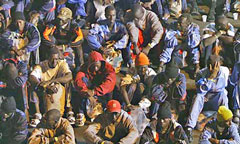
I spoke with three refugees on their way to Europe.
One had come from Sudan, another from Somalia and the third from Uganda.
They had made their way through Africa over many months, enduring unimaginable hardship.
They talked about eating insects and drinking urine to stay alive, going a year without a shower and hiding in mountains, stowing away on buses and undergoing human rights violations, losing a sister to the harsh elements of the Sahara Desert and struggling to find work.
After they chronicled these abuses and degradations, I wondered how they could speak about God in this kind of hell.
I asked the refugee named Emmanuel, “Have you ever wondered how all this can happen to you if God is love?” Quickly and emphatically he responded: “The problem is not with God; it is with human beings. God does not want us to go through all this or live this way.”
Though not the first person to articulate this insight, Emmanuel’s marginal social setting gave his words particular clarity and authority.
I listened attentively for three days. In time I realized that the refugees’ experiential data and initial theological insights were only part of the equation and that sometimes one’s understanding of God must undergo a total course correction.
When Emmanuel discovered that I did research on migration and theology, he said: “Some people say the reason we are suffering so much here in Africa is because we are descendants of Judas; because of what he did to Jesus we are paying the consequences.
What do you think of that?” This was a theological statement, a debilitating one.
His words caused me to look for a critical correlation between his experience and the liberating message of the Gospel.
I began to share with these refugees a theology of migration, based on the truth that God in Jesus Christ so loved the world that he left his homeland and migrated into the far distant territory of humanity’s sinful and broken existence.
There he laid down his life on a cross so that we could be reconciled with God and migrate back to our homeland, where there is peace, harmony, justice and life.
I went on to explain how God’s love in Jesus is so boundless that it cannot be walled in or contained by human attempts to constrict it.
God always crosses over the divisions we create in order to help us find a right relationship with God and each other.
First, a theology of migration crosses over the nonhuman-human divide and so brings out the dignity of the human person, especially those who, like migrants, are treated like insects, dogs or slaves.
Second, it crosses the divine-human divide, and thus helps us see the utter gratuity of God, who moved from his homeland with a love that could not be limited by legal or political policies and reached out to those whose lives are most threatened—the sinner, the tax collector, the prostitute, the outsider and the poor.
Third, it crosses the human-human divide, as is revealed in Jesus’ ability to cross racial, religious, political, economic and social barriers to foster a vision of human solidarity that highlights our interconnection as one family of God.
Fourth, it crosses the country-kingdom divide, where we begin to see beyond national identities in recognition that the Christian’s true citizenship is in heaven; our true calling is to cross borders as agents of God’s reconciliation.
As pilgrims of faith, Christians are spiritual migrants searching for a true homeland, an identity that should make us more sympathetic to all people on the move today.
I said that the word alien describes not those who lack political papers but those who have so disconnected themselves from their neighbor in need that they cannot see in the stranger an image of themselves, a reflection of Christ and a challenge to human solidarity.
After I finished speaking, Emmanuel suddenly jumped up from the table, raised his eyes to heaven and shouted in a loud voice, “Yeah God! I can’t believe you would be that good to me!”
My own life and words became invisible to him; what remained was not theology but doxology, not words but praise.
More than factual retrieval, brilliant concepts or propositional truths, theology is about an engagement of faith with life that heals and empowers as it seeks to discern the fingerprint of God in a common sojourn from creation to new creation.
|
Seeking practical benefits from national reconciliation in Myanmar
Trevor Wilson
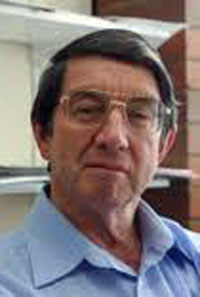
Trevor Wilson is Visiting Fellow in the Department of Political and Social Change, College of Asia and the Pacific, Australian National University. He is a former Australian Ambassador to Myanmar
| There can be no doubt that Myanmar is currently undergoing an important political transition. In most cases where such a political transition occurs,
it is accompanied by a significant process of “national reconciliation”, especially where politics have been profoundly divided and polarised in the past.
A genuine process of “national reconciliation” is now happening for the first time in Myanmar in at least 20 years, targeting different segments of the population.
The collective efforts of all Burmese, at home and abroad, and their supporters, are being encouraged in this process of national reconciliation, and their contributions have the potential to generate vital practical benefits for the people of Myanmar in a relatively short space of time. The process also has implications for the international community.
The idea of using national reconciliation to help achieve this goal of bringing practical benefits is much more than a romantic or sentimental goal.
Politically, as well as practically, it could be an absolutely essential step if efforts towards reform are to succeed and be sustained.
There is a substantial, but regrettably still incomplete, consensus about working towards a collective contribution to this national reconciliation.
Many examples can be found of the concrete benefits that might help the process of transformation that everyone aspires to.
There is ample evidence that Myanmar’s current transition depends critically on the human talents available to devise and implement the change programs the Myanmar Government has adopted.
It is not hard to see why this should be so, when account is taken of the fifty years of enforced isolation and conformity under Ne Win (1962-88) and the State Peace and Development Council (1988-2011), which essentially left Myanmar behind even its small ASEAN neighbours Laos and Cambodia in some aspects of socio-economic development.
Myanmar’s leaders on all sides have publicly acknowledged their worries about the current capacity building deficit. Aid donors are concerned about Myanmar’s ability to absorb the increased levels of aid that are already being foreshadowed.
One way to overcome the large gap in human resource capacity is for overseas Burmese to return to help achieve changes, as happened in other ASEAN countries like Cambodia, Laos and Vietnam. By and large, there are no longer compelling reasons for Burmese living overseas to fear going “home”, and some high-profile Burmese have already done so.
The challenge of national reconciliation
“National reconciliation” can be defined as a process that involves all the different groups that make up a “nation” wherever they are located, and whatever ethnic, socio-economic and political position they occupy.
Focusing on matters of national purpose and a national agenda can help mobilise support for the process, thereby strengthening it.
Of course, this is a “political” statement, although it is arguably something on which a strong and resilient consensus among all groups is achievable.
In Myanmar, national reconciliation is a “home-grown” product; it is not being facilitated or imposed from outside; while the United Nations is supportive, it does not play a direct role; the burden of responsibility falls directly on national political leaders.
So it is no surprise that Myanmar’s current political leaders views on “reconciliation” are almost identical. Their views include the following statements:
Daw Aung San Suu Kyi:
• Myanmar needs: “a more inclusive political process” to achieve national reconciliation which is something that is “in everybody’s interests”
• A genuine political dialogue with all ethnic groups is essential for national reconciliation.
President Thein Sein:
• “Releasing prisoners of conscience is an important step for advancing national reconciliation” (March 2012)
• “Confidence is very important for national reconciliation in our country.”
• “The expectation of ethnic groups is to get equal rights for all. Equal standards are also the wish of our government”
• “Ceasefires are needed on both sides first for political dialogue… We all have to work so our ethnic youths who held guns stand tall holding laptops.”
The August 2011 meeting between President Thein Sein and Daw Aung San Suu Kyi in itself was an important step for national reconciliation.
“We should all work together,” Ko Ko Hlaing, Political Advisor to President Thein Sein, said after the meeting.
The new Myanmar Government seems to be slowly making progress in its negotiations with ethnic groups, and most recently representatives from the Karen national Union and the government (and, separately, Aung San Suu Kyi) met again, inside Myanmar.
Realistically, such negotiations and such reconciliation will take some time; it will not happen overnight, or just through a piece of paper.
Mutual trust is essential, and for the first time in many years, we are seeing signs of growing trust.
Also needed are satisfactory arrangements to bring home displaced people along the border of Myanmar and at present located in Thailand.
Some attempts to return these people were made in the past, but did not work.
These people cannot be abandoned, but their trust in the authorities (Myanmar and Thai) needs to be restored. It should be possible to do this successfully.
Remember the example of thousands of cross-border returnees in the cases of Cambodia (370,000 people) and later in Laos.
Political Leaders’ Messages to the Burmese diaspora
On 17 August 2011 President Thein Sein for the first time issued a public invitation to the Burmese diaspora to return to Myanmar to contribute to national building.
He said:
• Any individuals and organizations in the nation that have different views from the government should not take account of disagreements and we invite them to work with us for common goals in the national interests.
We will make reviews to make sure that Myanmar citizens living abroad for some reasons can return home if they have not committed any crimes.
• The targets, he said are: “Everyone who is honest and good-hearted loves their homeland.
They want their country to enjoy prosperity and to live in amity and unity. And they have strong attachment to their country and own people, and build a peaceful and prosperous society.
That is our common ground. I would like to urge all to work hard together based on the common ground in order that our country will be able to stand tall as a peaceful and modern one in the international community.”
For the first time the new Myanmar Government has followed up by sending Railway Minister Aung Min (the government’s chief negotiator with ethnic communities inside Myanmar) to Bangkok to meet exile groups in February 2012.
[top of next column...]
|
There are already some examples or high-profile overseas Burmese who have returned to make their contributions include: Zaw Oo, former Director of Burma Fund, Washington; Dr Thant Myint-U, formerly based in New York, now resident in Bangkok, but working as a Director of the LIFT multi-donor assistance program and spending long periods in Myanmar.
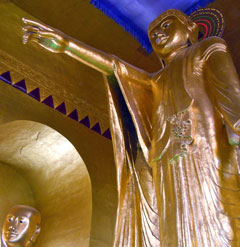
• Other examples include visits to Myanmar for the first time by the prominent exile media leaders Aung Zaw from The Irrawaddy, Aye Chan Naing from Democratic Voice of Burma (whose exile publications were formerly banned!); it seems that some of these journalist/proprietors (such as Democratic Voice of Burma – based in Thailand and Norway, and Mizzima News – based in India) will be making their contributions by setting up in-country publications.
Aung San Suu Kyi has also publicly supported the idea of exiles returning to make such a contribution to the task on national building.
In an important message to the April 2012 Burma Medical Association (Australia) seminar in Sydney, she asked BMAA members to “help in any way they could”. She did not impose any restrictions on this. She did not mention “sanctions”.
This has always been her policy, but she is now indicating that she believes that the time and circumstances have come when it is possible.
Why is there an important role the Burmese diaspora?
It is natural in a home-grown reconciliation process, that voluntary contributions should be sought from all those who would like to assist the process of re-building the nation.
There could be as many as three million Burmese living overseas at the moment, perhaps more. (This is half the population of Laos.) They have enormous talents and skills that they can contribute, many of which are missing or under-developed in Myanmar today.
Even in Australia there are now probably 26,000-30,000 people who were “born in Burma”. In recent years, this has been one of the fastest growing Asian communities in Australia, due to the numbers coming under humanitarian resettlement (especially Karen and Rohingya).
The 2006 Australian census – recorded approx 13,000 “born in Burma” (Note: Australia’s 2011 Census data are not yet released).
However, Australian Department of Immigration and Citizenship data shows that between the 2006 Census, and 31 December 2010, there were 8,847 permanent arrivals from Burma.
In other words, the Burmese community in Australia increased by 42 per cent in just over four years (2006-10). According to additional Department of Immigration and Citizenship data, arrivals from Burma in 2010-11 were 4,000 (c.f. Lao 2,000; Cambodia 8,000; Vietnam 54,000).
Finding the best contribution from overseas
What kind of contributions by exiles from Burma might be valued in Myanmar? Sectors such as:
• Financial system regulation and management;
• Judicial system: prosecutors, judges/magistrates, court officers;
• Setting up a proper national environmental protection framework and regulations;
• Social workers and counselling services, but there are many, many others.
In medicine, speakers at the Sydney seminar suggested many practical ideas, such as a establishing an integrated emergency management system, and a national pathology and diagnostic services regime.
The other important area, which needs to be assigned higher priority, is mental health, something that truly values individual human rights, and where a number of overseas Burmese hold qualifications.
Delivering strengthening programs effectively
Strengthening institutions that are reforming, and building under-developed human resources capacities are not only badly needed, but are also vital ways of trying to ensure that reforms in Myanmar cannot be reversed.
It may be important to strengthen both the government and non-government sectors. So international and national (Myanmar) Non-Government Organisations obviously have an important role in implementing such programs effectively and ethically on the ground in Myanmar.
INGO’s will need reliable and dedicated partners from Myanmar’s growing NGO community; the Myanmar Medical Association, for example, is already known and respected by Australian NGOs.
One can envisage a pattern of triangular collaboration, with donors and sources of expertise pairing up with recipient organisations, often with the inter-mediation of a facilitator or catalyst.
The ANU is trying to act as a catalyst in this way, encouraging its outstanding scholars to travel to Myanmar for educational and practical academic purposes and seeking ways to invite Myanmar scholars to Canberra.
The Australian Government has now introduced a special visa for “refugees” who have not taken out Australian citizenship but who wish to return temporarily to their country of birth.
The “Resident Return Visa” – is a permanent visa for current or former Australian permanent residents.
According to the official explanation, “This visa allows you to leave and enter Australia as often as you want, within the validity period of the visa, while maintaining your status as a permanent resident.”
In 2010 Department of Immigration & Citizenship data on permanent returnees did not mention Burma, even though figures under 10 were included.
(Highest number of returnees were from the UK, New Zealand and China; after that Vietnam was only 1,300; and Cambodians 169, of whom 115 had been in Australia more than 5 years.)
It should be possible to put “Myanmar/Burma” on the map here as well in the future.
Concluding remarks
The fact that the Burma Medical Association, Australia, could host such an ambitious, wide-ranging and enthusiastically supported global seminar, is strong evidence for the case that the collective efforts of all Burmese, at home and abroad, and their supporters, can be part of this process of national reconciliation.
It also demonstrates some of the specific potential for generating untold practical benefits for the people of Myanmar in a relatively short space of time.
The seminar was impressive as a brilliant model which other groups inside and outside Myanmar could follow.
April 16th, 2012, New Mandala: 'New perspectives on mainland Southeast Asia'
Note: This New Mandala post is based on a presentation to the Burma Medical Association (Australia) “Building Bridges” Seminar for “Strengthening Collaboration and Building the Collective Contribution of Overseas Burmese Health Professionals to Maternal & Child Health in Myanmar/Burma”, 10-11 April 2012, Sydney.
|
Fewer asylum claims in Australia

ACMRO publishes UNHCR report
| In its latest annual Asylum Levels & Trends in Industrialized Countries Report, released 27 March 2011, UNHCR noted that 441,300 people claimed asylum in the 44 industrialized countries covered by the study during 2011.
This represented a 20 per cent increase from 2010, when 368,000 claims were submitted.
The largest relative increases were seen in southern European countries - which recorded an 87 per cent increase - largely driven by the numbers of people fleeing North Africa by boat.
A large increase was also observed in North America, where new asylum applications rose by almost 25 per cent.
By contrast, the Report shows the number of asylum-seekers coming to Australia in 2011 declined by nine per cent - from 12,640 in 2010 to 11,510 in 2011 - largely due to a reduction in the number of people coming to Australia by boat.
The largest number of asylum claims in 2011 were received in the United States of America (74,020), France (51,910), Germany (45,740), Italy (34,120), and Sweden (29,650).
Globally, Afghans were recorded as the largest nationality of asylum-seekers in industrialized countries, followed by China, Iraq, Serbia and Pakistan.
The number of Afghans seeking asylum in the industrialized world was up by 34 per cent – an increase which has mostly been observed in Europe.
[top of next column...]
|
Going against this trend, Australia recorded a 45 per cent decrease in the number of Afghanis claiming asylum in Australia.
“This Report shows clearly that the numbers of asylum-seekers coming to Australia are modest - and certainly manageable - when compared to many other industrialized countries,” UNHCR Regional Representative Richard Towle said today.
“The recent introduction of a single system to assess refugee claims of both boat and air arrivals is a welcome step towards improving the efficiency, fairness and overall quality of the asylum system in Australia,” Towle said.
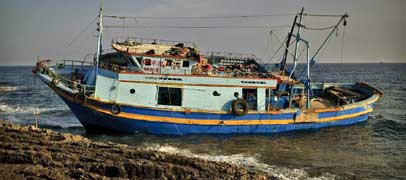
Three people died on this boat, which ran aground on Lampedusa after the dangerous journey from Libya. UNHCR, F.Noy, May 2011
“At the same time, UNHCR encourages Australia to maintain its commitment to working constructively and collaboratively with other states in the region under the Regional Cooperation Framework.
We are convinced that if people can be made safer and more secure in South East Asia then they will not need to place their lives in the hands of people smugglers and have resort to dangerous boat journeys to Australia,” he said.
AMCRO March News, 2012 |
Monks pray for 'remaining prisoners'
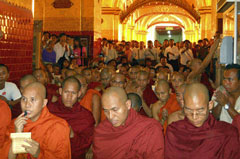
Buddhists want peaceful release of everyone left in jail after 'amnesty' freed many
| Hundreds of Buddhist monks gathered yesterday to pray for the release of all remaining political prisoners in the country.
Venerable Wirathu, who led the prayer event at the Mahamyatmuni pagoda in Mandalay, said his experiences as a political prisoner led him to focus on the plight of others prisoners of conscience.
“I am used to visiting the relatives of the remaining political prisoners, and I encourage them not to feel depressed,” he told some 500 Buddhist monks and others who attended the event.
“This has motivated me to organize this prayer program,” he said.
Venerable Wirathu was released from Myitkyina prison in Kachin state in January as part of a general amnesty that saw the release of prominent opposition leader Min Ko Naing of the 88 Generation Students and other prominent political activists.
[top of next column...]
|
International human rights groups estimate that hundreds of political prisoners remain in detention.
“I am determined to continue to try to [encourage the] release of all remaining political prisoners by peaceful means,” Venerable Wirathu said.
Yesterday’s event included the symbolic freeing of birds and fish.
Daw Tin Htay of Kyauksae city, Mandalay division, said her son was still behind bars for his political beliefs.
“My son is not a criminal,” she said, holding a vinyl sleeve of photos.
“My son is not yet free, though former spy chief Khin Nyunt who arrested her son has already been released,” read a note underneath one of the photos, referring to the former prime minister and intelligence chief deposed in 2004 and held under house arrest.
ucanews, Mandalay, Mar 23, 2012 |
Armed soldiers break up Myanmar Christian gathering
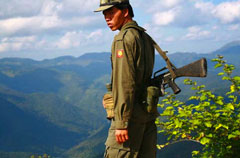
Despite the recent liberalizations, this incident - in which soldiers put a gun to the head of a local MP and mocked the government - shows there are still major human rights concerns in Myanmar.
| The Burmese army raided a building where a Protestant Christian Chin communities meeting was taking place, the soldiers pointed their weapons against the faithful, among whom there was also a State MP.
The incident occurred on March 10 last, but was only reported today by the Chin Human Rights Organization (CHRO) and re-launched by dissident website Democratic Voice of Burma (DVB).
Meanwhile, the U.S.Commission on International Religious Freedom (USCIRF) today issued the 2012 report on abuses and violations, which shows that Myanmar placed on the "worst list" along with China, Egypt, Vietnam, Iraq and Korea North.
The U.S. experts judgment cites the ongoing civil war between the government army and the Christian minority Kachin in the north, where sectarian elements are combined with political demands.
Sources told the Chronicle that last March 10, Burmese soldiers led by two army captains interrupted a meeting of a thousand delegates to the Evangelical Church of Chin Matupi, a town near the border with India, in Chin State (90% Christian).
The military ordered those present to show permits for the conduct of the gathering, according to "rules governing Christian worship and assembly of the faithful."
[top of next column...]
|
Among the Christians present, there was also Pu Cin Van, Chin State Member of Parliament, belonging to the Ethnic National Development Party.
One of the two officers put a gun to the politician's head mocking him: "I do not care if you are a member of parliament - the soldier is reported to have said. "Here we are not under the authority of government, we only take orders from the Regional North -Western Command. "
Human rights activists denounced the abuse committed by the military in a nation controlled by the army for decades, which abuses rights and personal freedoms. Salai Za Uk Ling, director of Chronicle, points out that "it is very difficult for Christians to organize a demonstration, without assaults and abuse."
He confirms that "the army continues to violate human rights, despite the January peace accords."
A year ago the military junta handed over power to a civilian government and General Than Shwe - strong man in the country - has retreated behind the scenes.
However, the army's influence is still strong, especially in areas of war particularly the States that are home to ethnic minorities that form, along with Burmese, the Union of Myanmar.
Asianews Agencies, Mar 23, 2012 |
Ceasefire not enough
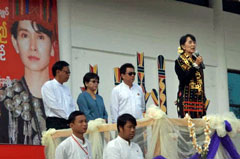
Aung San Suu Kyi
speaks to Kachins
| In a one-hour speech to many thousands of her supporters in Myitkyina on the second day of a visit to the war-torn state on February 24, Daw Aung San Suu Kyi said: “Everyone wants to live in peace. "
The Burmese democracy leader stressed the need for ‘genuine peace’ in the wake of continued fighting in Kachin in her National League for Democracy (NLD) campaigning in the state.
"First, we must be free from fear. We should not have fear when we wake up in the morning or at night when we go to bed.”
She said she was concerned about the fighting
“In Kachin state, it is a problem that there is no peace right now. We must consider why we don’t have peace, don’t trust each other and don’t respect each other.”
“We don’t trust and respect one another because we are not open and honest to one another.” Suu Kyi added.
Amid fighting between government troops and the Kachin Independence Army (KIA) since June 2011, more than 50,000 people have been displaced and are taking shelter in Kachin State and China border areas.
[top of next column...]
|
She said there had been a ceasfire in Kachin for some years. “But a cease fire does not mean that we achieve peace.
The most important thing is that we must reach a certain political solution. Then, our country will be peaceful.”
“We can’t achieve genuine peace through fighting but through political talk and peaceful means.”
Suu Kyi said: “If we don’t have peace, we can’t build development in our country. If our country does not have peace, it can affect our country’s future and interest.
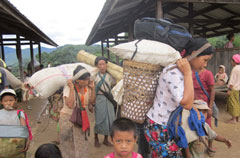
So, we should consider the Kachin issue as our family issue. We must share this suffering in Kachin state as our suffering.”
Many supporters clapped and waved the NLD’s fighting-peacock flag in support and others wore T-shirts bearing Suu Kyi’s image.
ucanews.com Feb 27, 2012
|
Bishops call for humane approach toward asylum seekers
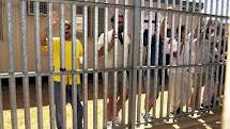
Australia sense of justice and compassion means limited detention -- three months maximum suggested by bishops.
| The Catholic Bishops Commission for Justice, Ecology and Development has called on political parties to mark Australia Day by working towards a common approach to asylum seekers - and put a limit to their time in detention, the bishops said in a statement.
"Further, and more immediately, to honour the Australian sense of justice and compassion, there must be a defined limit to incarceration in detention centres for people who are not criminals," the statement said.
The Bishops are calling on the Government to limit detention to three months.
Four of the Bishops who signed the statement minister directly to asylum seekers in immigration detention centres located in their dioceses. Bishop Julian Porteous, Auxiliary Bishop in Sydney, supported the opinions of the other Bishops who have direct involvement in the pastoral care of asylum seekers in detention.
"Prolonged and indefinite detention in these facilities can only produce psychological damage", he said.
"In citizenship ceremonies around the country on Australia Day we will again celebrate the great contribution migrant families have made to this great nation", said Archbishop Adrian Doyle of Hobart.
"We should be particularly proud of Australia's generosity over the years in providing refuge to vulnerable people fleeing their homelands. It is important that we also remember the men, women and children currently being held in detention centres."
Bishop Gregory O'Kelly SJ of Port Pirie said: "Minister Chris Bowen announced last November that the Government would issue around 100 bridging visas each month for the community placement of asylum seekers.
[top of next column...]
|
"This announcement recognises that prolonged detention does serious harm to vulnerable people. While this brings the Government closer to its 2008 commitment that detention would be used as a last resort and for the shortest practicable time, the dire circumstance of many detainees requires more immediate action.
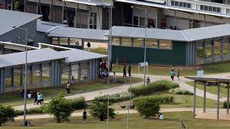
"In Port Augusta we have thirty young people, nearly all minors and some in primary school, who have been in detention now for twelve months, at Christmas Island and there.
"The secondary school age minors have not been permitted to attend school.
"They are taught English for one hour a day. Apart from that one hour a day there is only an occasional activity to occupy them. Imagine how harmful the tedium is to growing young spirits.
"Despite a letter issued by the Minister last September, even though the minors are Catholic they are
not permitted to attend the nearby Catholic school.
"We know that no parent and no politician would want their own children to undergo such a regime for so long," he said.
Jan 24, 2012
|
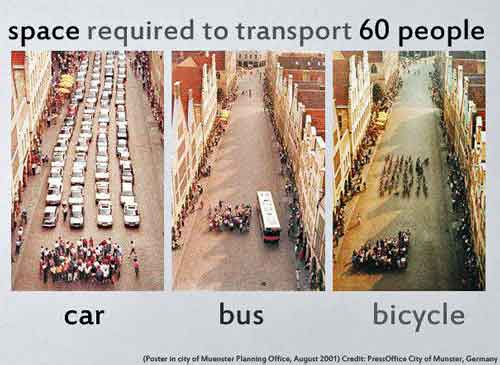
Transporting 60 people -- how some look at their environment
(courtesy, City of Munster, Germany) |
 |
Karen National Union, Burmese government reach historic agreement
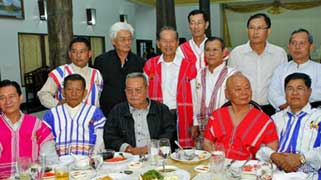
Saw Yan Naing
The Irrawaddy | After more than six decades of uninterrupted armed resistance to Burmese rule, the leaders of the Karen National Union (KNU), Burma’s oldest ethnic armed group, have signed a ceasefire agreement with the government.
The historic agreement, the first since the KNU began its struggle for Karen autonomy shortly after Burma achieved independence from British colonial rule in 1948, was signed at 2:57 pm on Thursday following talks between a government peace delegation led by Railways Minister Aung Min and KNU representatives led by Gen Mutu Say Poe at the Zwegapin Hotel in the Karen State capital Pa-an.

Under the agreement, the two sides will initiate a ceasefire and allow each other to conduct unarmed patrols in their respective territories.
The KNU will also be allowed to set up liaison offices in government-controlled areas.
According to a local source who asked to remain anonymous, the KNU delegation will travel next to the Mon State capital Moulmein and later visit Pegu, a central Burmese city near Rangoon with a large Karen population, where the KNU is considering opening a liaison office.
The KNU representatives arrived in Pa-an on Wednesday, where they were greeted by thousands of Karen people and attended a dinner hosted by the government peace delegation.
Several KNU central committee members, including David Taw, Roger Khin, Ah Toe, Aung Maung Aye, Kwe Htoo Win and Brig-Gen Saw Johnny, as well as representatives from all seven KNLA Brigades except Brigade 5, accompanied the peace delegation.Ngwe Soe, who helped to broker the talks, said that both sides agreed to meet again for further discussions.
A meeting is tentatitively scheduled to take place in Naypyidaw in 45 days, he added.
[top of next column...] |
Despite the unusually upbeat tone coming out of the talks, however, there was still a note of caution in some of the comments coming from those close to the negotiations.
“This time they didn't ask us to give up our arms, they just want to work for equal rights for ethnic groups.
This time we trust them,” Saw Johnny told Agence France-Presse, before adding: “We have been fighting for 60 years and one meeting alone will not end it.”
Several other ethnic armed groups, including the United Wa State Army, the Shan State Army-South, the Chin National Front and the National Democratic Alliance Army, have also recently reached ceasefire agreements with the government.
As a key member of the United Nationalities Federal Council (UNFC), a coalition of ethnic armed groups formed in February 2011, the KNU has called on the government to enter into an inclusive dialogue with all UNFC members to reach a lasting political settlement that addresses ethnic concerns.
However, according to a UNFC source, the group has agreed in principle to allow its members to enter into individual ceasefire agreements with the government, on the understanding that this will later lead to political talks involving all of the groups concerned.
Founded in 1947, the KNU formed its military wing, the Karen National Liberation Army (KNLA), in 1949 and immediately began an armed insurgency against Burma's central government.
Although the group has never signed an official ceasefire agreement with the government, in 2004, the late KNU leader Bo Mya and former government spy chief Khin Nyunt verbally agreed to halt hostilities following talks in Rangoon.
However, the fragile informal truce soon broke down.
The Irrawaddy
Jan 12, 2012
|
The vultures prey...
As Christmas fades, Fr Jim Carty SM recalls the vultures of Sudan -- and the modern-day vulture funds preying on the economies of the world's poorest nations...
| You have probably seen this photo before; it was taken back in 1993.
Again you shake your head and wonder why, using such a photo, I write such melancholy stories so close to Christmas time.
After all, as the huge Christmas tree in central Martin Place Sydney declared, this is the season of "peace, joy, hope and love".
The photo was taken on the 23rd March 1993 by photographer Kevin Carter on his trip to southern Sudan.
He took this iconic photo of a vulture preying upon an emaciated Sudanese toddler near the village of Ayod.
Carter said he waited about 20 minutes, hoping that the vulture would fly away. It didn’t. Carter snapped the haunting photograph and chased the vulture away.
(The parents of the girl were busy taking food from the same UN plane Carter took to Ayod).
The photograph was sold to The New York Times where it appeared for the first time on March 26, 1993 as a grim image for Africa’s despair.
Practically overnight hundreds of people contacted the newspaper to ask whether the child had survived. Her ultimate fate was unknown and Carter came under criticism for not helping the girl.
“The man adjusting his lens to take just the right frame of her suffering might just as well be a predator, another vulture on the scene,” said one editorial.
“Carter eventually won the Pulitzer Prize for this photo, but he couldn’t enjoy it. “I’m really, really sorry I didn’t pick the child up,” he confided in a friend.
Consumed with the violence he’d witnessed, and haunted by the questions as to the little girl’s fate, he committed suicide three months later.”
Again, why the photo? Is it to disturb? To make us feel guilty?
No, although I am disturbed and I do feel guilty, but the reason I use it is to acknowledge that we have such a long way to go to make the words on the tree a reality in our troubled world.
Sadly, I also use the photo to recall (how easy it is to forget) that once again in 2011 we have been confronted by the harrowing images of thousands of starving Africans trudging through the desolate wastes of the Horn of Africa in their quest to survive.
The stories this time are equally graphic and unnerving. One in particular weighs heavy on my memory.
Among the hundreds of thousands of refugees was a woman with four children.
Because all her cattle were dead, her crops withered, and she was unable to feed her children, she set out on bare foot (not Running Bare) from her village in Somalia to a Refugee Camp in Kenya in a desperate effort to save her children.
Without food and little water she carried, dragged and urged her children along in the burning sands of the desert tormented by furious dust-storms and raging thirst.
On the way one of her children collapsed unable to continue.
The mother was faced with a horrifying Sophie’s choice: stop and stay with the sick and probably dying child and risk the lives of the other three children or abandon him in the desperate hope of reaching the camp and saving the others.
She left him. But she will forever carry the haunting look of fear, despair and desolation in the eyes of her child as she turned to go.
His fate is unknown but she and all those ragged, emaciated, suffering lines of humanity seeking safety knew only too well of the hyenas opportunistically dogging their heels for any who fell by the wayside.
[top of next column...] |
After 18 days the mother and her three children arrived at the camp in Kenya.
Caritas reports that the 2011 drought is the worst drought in 60 years, almost all the new refugees are from Somalia.
They are arriving in shocking health and nutritional conditions.
Over the last seven weeks, Ethiopia’s population in need, increased from 3.2 to 4.5 million; Kenya from 2.4 to 3.75 million and Somalia from 3.2 to 4.5 million*.
This is a far-reaching crisis affecting women, men, children and the elderly. (Compare these staggering numbers with the trickle of refugees permitted each year in Australia- Limit? 13,700 which may be increased to 20,000 on the condition of accepting the morally bankrupt Faustian trade off of accepting the Malaysia Solution)
I also chose this photo as a metaphor for a far more pervasive, insidious and destructive kind of vulture than the feathered variety in the photo.
One that prowls the world in pin striped suits- and is known as the buyer and holder of Vulture Funds
.
And what are Vulture Funds? I am grateful to the “Guardian” for helping to explain
It has been 16 years since most of the world began writing off the debts of the poorest countries, but the vulture funds, a club of between 26 and 35 speculators, have done almost everything to ensure that these countries do not have a chance to get back on their feet; they have ignored the debt concerts by pop stars such as Bono and pleas from the likes of the World Bank and International Monetary Fund (IMF) to give the countries a break.
What happens? Vulture funds operate by buying up a country's debt at a great discount when it is in a state of chaos.
When the country has stabilised, vulture funds return to demand millions of dollars in interest repayments and fees on the original debt. New York vulture fund FG Hemisphere has gone to Jersey Island (a tax haven) to claim $100-m from the DRC, because a legal loophole means that the Island remains free of anti-vulture laws that were passed in the U.K. last year.
It purchased the $100 million debt for the bargain price of $3.3 million and is likely to win its case. How venal can one get?
Contrasts: The DRC should be one of Africa's richest countries. It has a mineral wealth estimated to be around $24-trillion (£15-tn).
There are huge deposits of cobalt, diamonds, gold, copper, oil and 80 per cent of the world's supplies of coltan ore — a valuable mineral used in computers and mobile phones. (How many of us use these?)
Yet 100 women a week are still dying in childbirth and 16,000 children under the age of five die every year. One in three children in the DRC will never get anything more than primary education.
So far, according to the World Bank, the top 26 vultures have managed to collect $1-bn from the world's poorest countries and still have a further $1.3-bn to collect.
Gordon Brown, the former British Prime Minister and long-time Finance Minister in Tony Blair's administrations, has described the payouts as ‘morally outrageous.”
As we prepare to farewell 2011 and welcome in 2012 can we justifiably expect that things will change?
Can we realistically hope to make a difference to the lives of some who like that little child whose kneeling posture seems like a plea to us for help?
Maybe we can make a difference in a small way in the coming year so that next year’s letter will be filled with reasons to hope, to be filled with joy, to live in peace and to be reconciled in love.
Posted, New Year, 2012 |
 |
Bringing Justice to the Women of Burma
From the Marist Mission Ranong, Thailand, Fr Kevin Medilo SM alerts us to the plight of women, young and old, in Burma, as depicted in a recent YouTube clip released by the Women's League of Burma.
Military violence against Shan, Kachin and Karen groups are especially brutal in the rape and muder of women and girls.
Click here or on 'Bringing Justice to Women' (below). |
|